Chapter 4: Willow and Wolf
Salem Witches // Family Recipe: Willow Water for pain relief // Ancient Texts // Wolf tricks

Quick recap: My peculiar mother hid things in boxes, secreted under an 18th-century house in the woods, with a stream running through its basement. I’m researching each mysterious object and document to figure out where it fits in the story. Last week: The Brothel Secret.
THE MYSTERY:
WOW! Sorry I’m late! As I was writing this week’s, I noticed a small detail in a document that led me into a joyous, nerdy history detour. It was the word, WITCH.
In an envelope addressed to my grandpa Elwood Lincoln Baxter, I was surprised to find an incomplete Daughters of the American Revolution application from his aunt Olive (one of many family members named for trees).
I mentioned this to my dad, and he said, "Yeah, the Baxters were like, Puritans, or something."
The Baxters?!? Puritans?!? That did not track. I've written here about a certain shall-we-say lack of restraint that seemed to run in that part of my family.
Drawing on both genetic data and primary sources, I found several ancestors who fought in the Revolution, including Ichabod's father, John. But these people were Celts, not Puritans. Recent convict and bond-slave arrivals from Scotland and Ireland, they set about creating enormous families. John’s wife had one child in 1775 and 12 more after the war. She must’ve been tired.
But who were John’s ancestors? Had they ever been Puritans? I went back further and discovered that the other side of John's family had been here since the 17th century. And that my 6th great-grandmother, Margaret Jacobs, was a convicted Salem Witch. Margaret's mother, father, and grandfather were also convicted. (More on them next week.)
The Trial of George Jacobs, August 5, 1692 by Tompkins H. Matteson, 1885.
This week is about Margaret's father, George Jacobs Jr.

George Jacobs Jr., Margaret's father, was known around the village as a menace. He is the earliest trace of what I call my family's "crooked branch."
In May 1674, eighteen years before the witch trials, he was sued for herding his neighbor Nathaniel Putnam's stray horses into the river, where they drowned.
The court ruled against him.
SALEM PANICS
The Salem Witch Trials began during the winter of 1692/3. A group of girls and young women instigated a wave of accusations that ended in the incarceration of more than 200 people and the deaths of 25, in a village of only 500 -600 residents. (Imagine an IRL 2020-era Twitter mob that wore bonnets and could execute.)
Initially, the girls targeted outsiders: an Indigenous woman, all the Quakers, the town drunk, and a mentally ill widow. The accusers faked seizures or “fits,” screamed in agony, and pierced themselves with needles. Envy, perceived slights, and resentment over real estate fueled the expansion of this petty, deadly storm. As the hysteria spread throughout the community, so did the small-town score-settling.
The leadership of the Massachusetts Bay Colony established a new court system to codify and celebrate the sanctimonious hysteria. The young accusers, once relatively powerless, embraced their newfound authority with enthusiasm. Many of them were survivors from (the tragic and rarely discussed) King William’s War and King Phillip’s War and were likely traumatized by witnessing the deaths of family members in recent battles with the Wabanaki Confederacy.
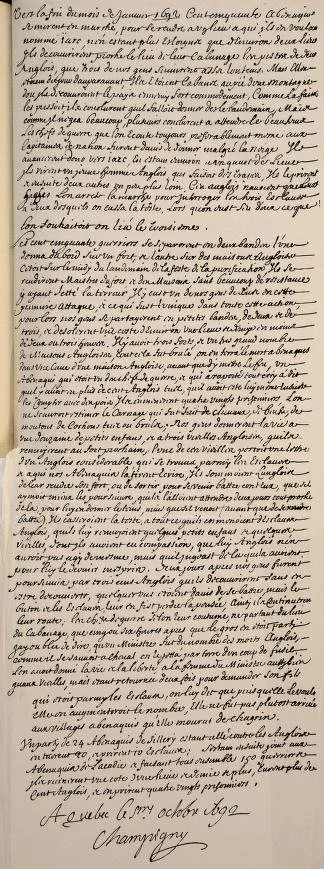
"…beholding of the Pillours of Smoke, the rageing of the merciless flames, the insultations of the heathen enemy, shooting, hacking, (not having regard to the earnest supplication of men, women or Children, with sharp cryes & bitter teares in most humble manner), & dragging away others, (& none to help), is most affecting the heart."
THE WITCH HUNT COMES FOR THE JACOBS
On May 10, 1692, constables arrived to arrest George Jacobs Sr. and his granddaughter, Margaret. The 84-year-old patriarch, walking with two canes, was shocked when they arrested him. Margaret was 17.
The Jacobs Accused
Four days later, on May 14, 1692, constables arrived at George Jr.'s house with warrants for him and his mentally ill wife, Rebekkah.
Warrant for George Jr. and Rebbekah
George Jr. fled before the constables arrived.
He left behind:
His wife, Rebekkah (thought to have been suffering from a brain tumor), his daughter, Margaret, already imprisoned, four children ages 2 to 15, and his breastfeeding newborn baby.
REBEKKAH
A record of Rebekkah's heartbreaking arrest exists in a remarkable book by Robert Calef:
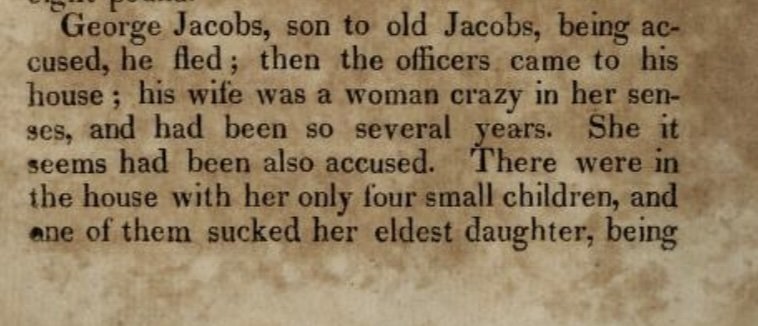
"George Jacobs, son to old Jacobs, being accused, he fled; then the officers came to his house; his wife was a woman crazy in her senses, and had been so several years. She it seems had been also accused. There were in the house with her only four small children, and one of them sucked… (nursed)
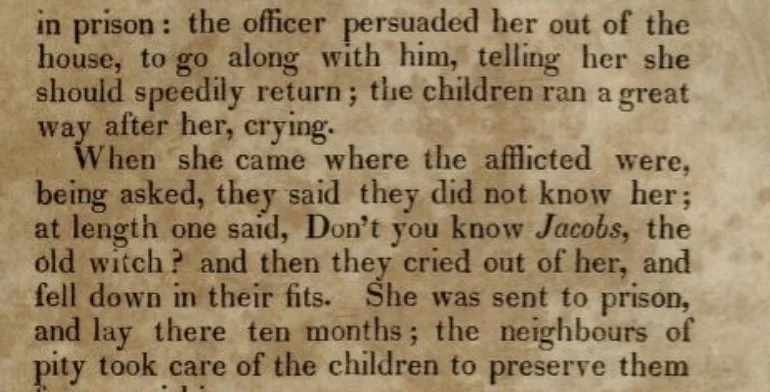
…the officer persuaded her out of the house, to go along with him, telling her she should speedily return; the children ran a great way after her, crying."
Whether the baby was ripped from her arms is debated, but other witnesses describe Salem toddlers waddling down muddy roads after the carriages in which their accused mothers were hauled away, screaming for them.
Calef continues: "When she came where the [accusers] were…they said they did not know her…"
Someone prodded the girls, reminding them that this was Rebekkah, (you know…the one you said was a witch):
"Don't you know Jacobs, the old witch? and then they cried out of her, and fell down in their fits. She was sent to prison, and lay there ten months; the neighbours of pity took care of the children to preserve them from perishing."
WITCH BITCHES
While George Jr. fled, his father, George Jacobs Sr., stood trial.
George Sr. and George Jr. were accused of witchcraft after Sarah Churchill (a servant) overheard them joking about the accusers, drunk with power.
They called them "The Witch Bitches."
When I read that, I thought: That tracks as Grandpa Elwood’s family.
George Jacobs Sr., my eighth-great-grandfather was known for being salty and blowing off church. He was 84 - a remarkable age. He walked with two "sticks," or canes, due to osteoarthritis. He was shocked when they came to arrest him, though records show that the Jacobs family were not Puritans.
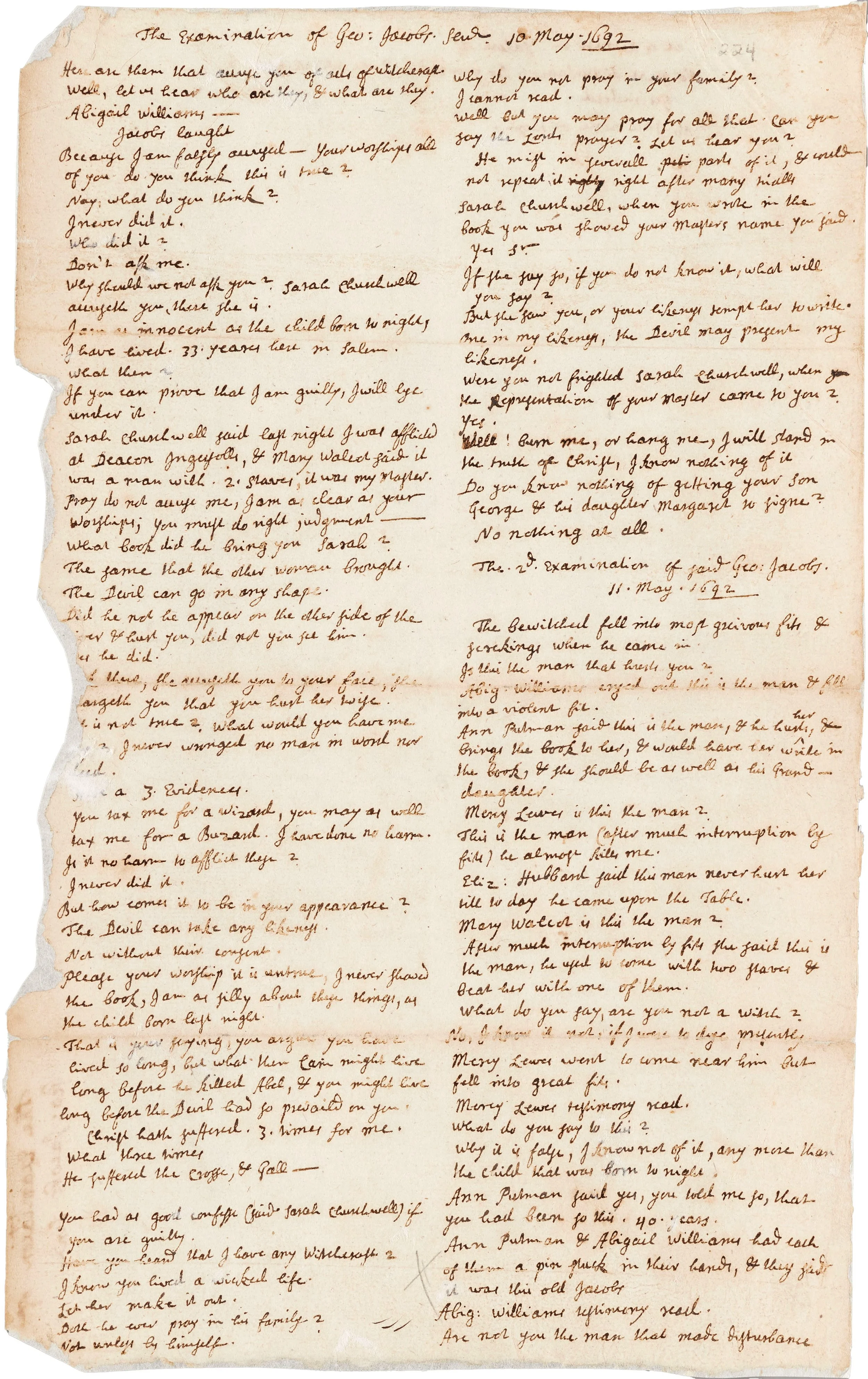
During his trial, he seems exasperated:
[If] you [accuse me of being] a wizard,
you may as well [accuse me of being] a buzzard.
I have done no harm.
Jacobs had already spent considerable time in a Puritan jail, hungry, cold, and ailing. The trial was all shrieking and writhing and took place in a tiny, crowded room.
The Trial Transcript: (excerpted)
May 11, 1692
The bewitched fell into most grievous fits & shriekings when Jacobs came in.
Judge: Is this the man that hurts you?
Abigail Williams cryed out, "This is the man!" & fell into a violent fit.
Ann Putnam said, "This is the man!" & he hurts her, & brings the [Devil's] book to her, & would have her write in the book…
Judge: Mercy Lewis is this the man?
"This is the man…(after much interruption by fits) he almost kills me!"
Eliz Hubbard said the man never hurt her till to-day he came upon the Table.
Judge: Mary Walcott is this the man?
After much interruption by fits, she said, "This is the man, he used to come with two staves" & beat her with one of them…
Mercy Lews [sic] went to come near him, but fell into great fits.
Judge: What do you say to this, [Jacobs]?
"Why it is false, I know not of it, any more than the child that was born to-night…"
George Jacobs Sr. was hanged on August 19, 1692.
One week before his execution, on August 12, he changed his will. He cut his son George Jr. out entirely, leaving his estate to his grandson instead.
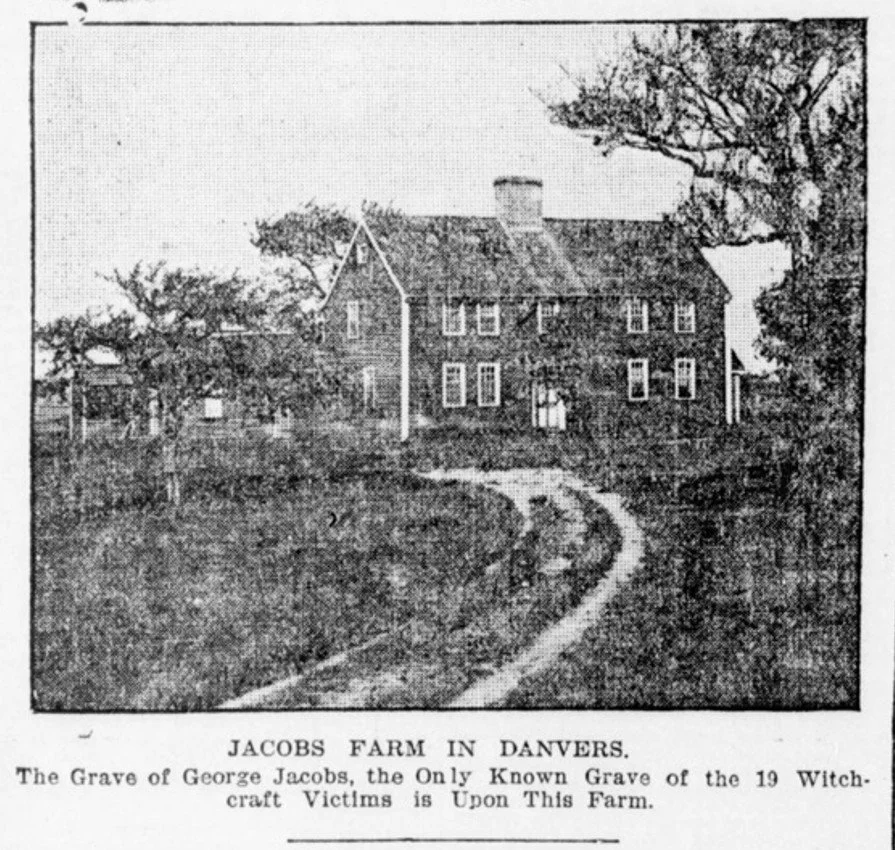
GEORGE JR. HITS THE JACKPOT
George Jr. didn't return until long after the trials ended and all was safe.
Rebecca was kept in prison. She'd been exonerated because even the innocent were expected to pay their jail fees. After three more months, her family finally scraped together enough to pay the poor woman's fees.
When George Jr. came back, he immediately petitioned the Massachusetts government for reparations funding, receiving one of the biggest awards. He then sued to inherit all his father's property, despite being disinherited, and won.
Rebekkah never recovered from the experience.
ROBERT CALEF VS. COTTON MATHER
Robert Calef collected first-hand accounts of the trial in his book, More Wonders of the Invisible World, published in 1700.
Today, we would call Calef's book title a troll.
During the trials, Cotton Mather, an influential preacher and the son of the dean of Harvard, wrote a book, Wonders of the Invisible World, in which he argued for the validity of the trials and the legality of the "spectral evidence" the accusers provided.
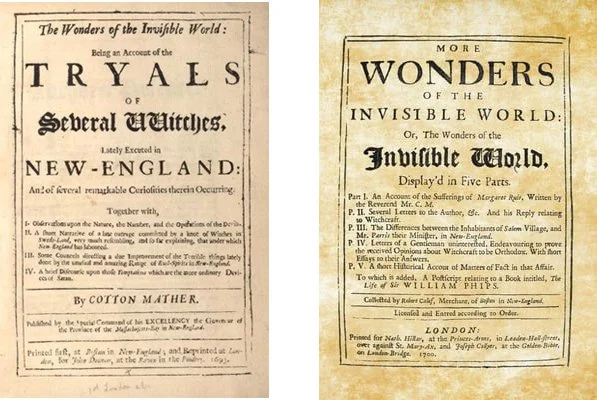
Mather’s Title Page vs Calef’s.
Calef ensured his book was printed at the same press in London that Mathers had used, making them more interchangeable. Even today, when you look up Mather’s book online, Calef’s book comes up in the search.
An uneducated tradesman, Calef was furious at Mathers for:
"a Biggotted Zeal, stirring up a Blind and most Bloody rage, not against Enemies, or Irreligious Proffligate Persons, But…against as Vertuous and Religious as any they have left behind them in this Country…"
Calef builds his argument with eyewitness accounts, the contemporaneous personal letters of the accusers, and trial documents. He includes passages from Mather's book, which, recontextualized, read as self-serving, irresponsible, and lethal.
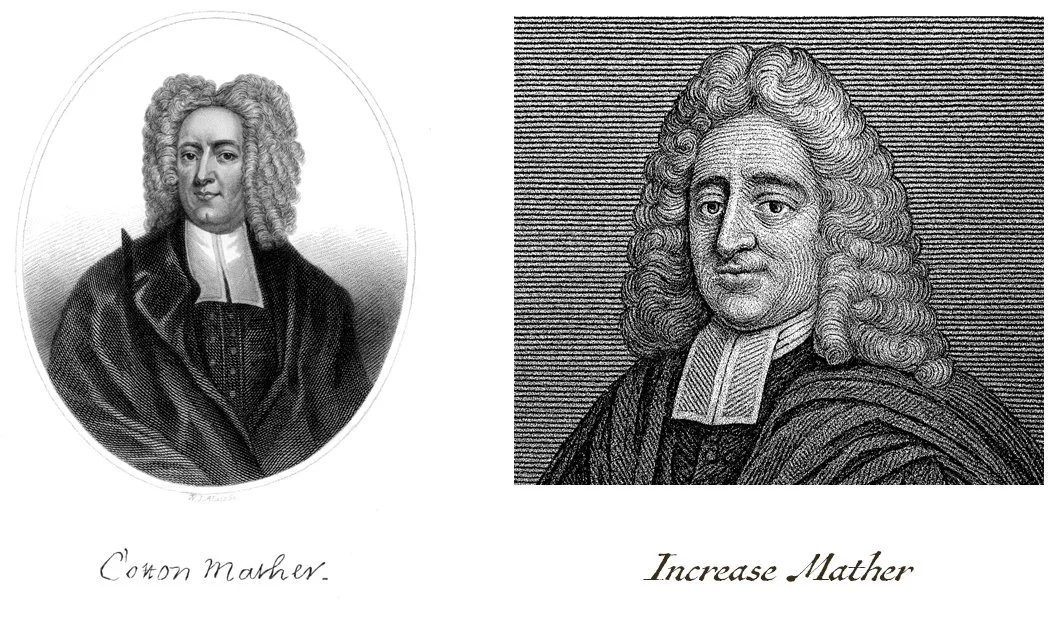
When being sanctimonious runs in the family.
Cotton Mather's father, Increase Mather, publicly burned Robert Calef’s book at Harvard Yard. But Calef won the war of words.
Within a year, Increase Mather lost his deanship, and both Mathers lost all credibility.
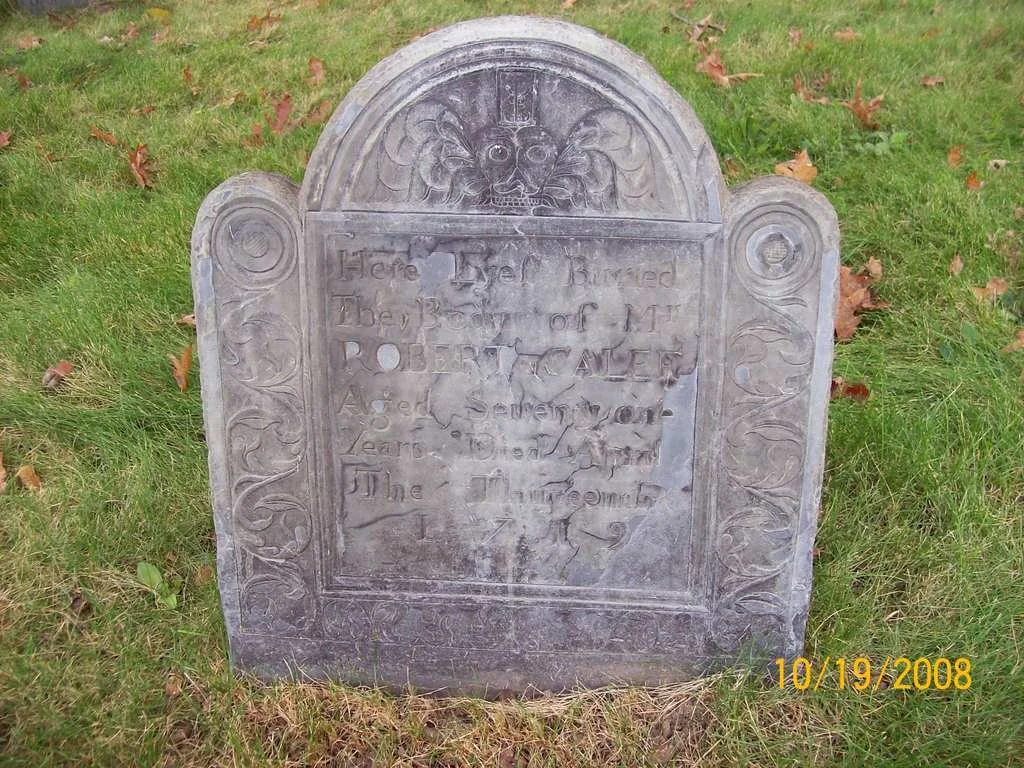
There is no portrait of Robert Calef, who was working class. Here is his gravestone. May he rest in peace #hero.
Recipes: WOLF AND WILLOWS
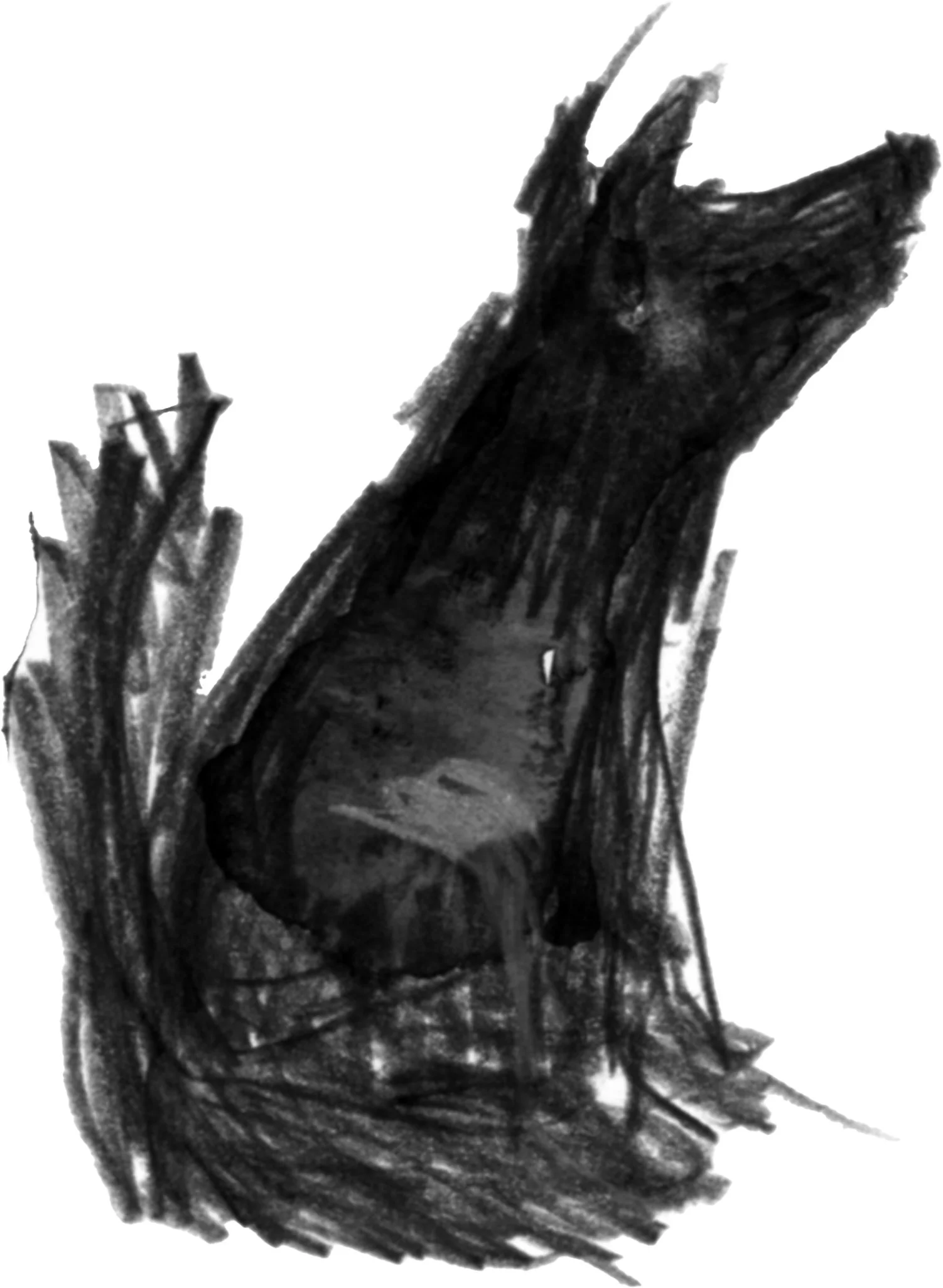
Wolf and Willows refers to an ancient story of traps and sorrow in this incredible book.
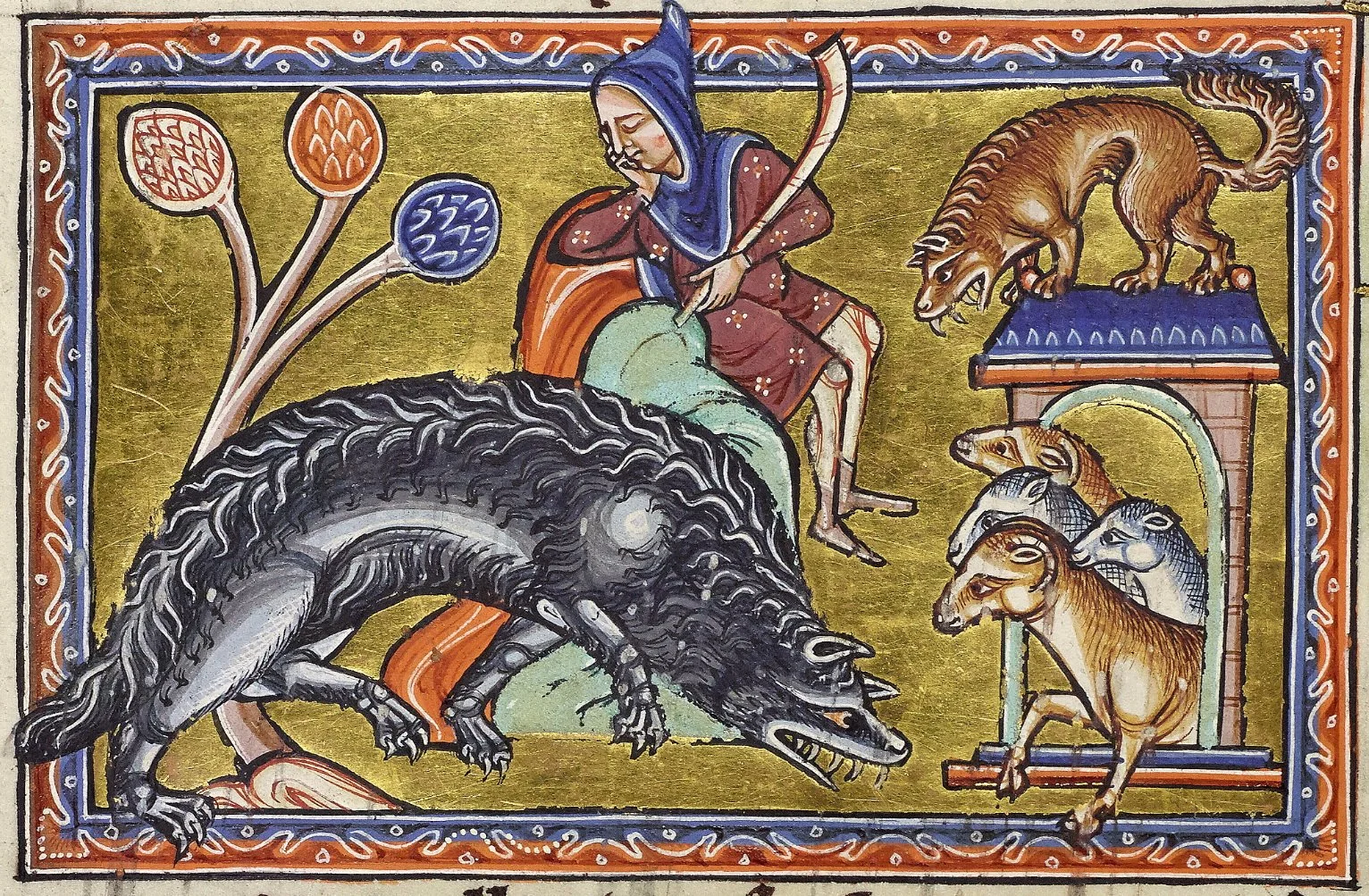
[The Wolf] gathers the leaves of the willow in its mouth and hides itself under them, so that it can secretly catch the goats coming to the leaves. When a wolf walks among the leaves, so as not to be perceived by the noise, it licks his feet with his tongue, and thus makes them slippery and moist, so that the dogs may not hear them. A wolf has dull vision by day, but sees more clearly at night. But the animals which see more clearly at night are often overshadowed by day.
BONUS Family medicine recipe:
from Plant Magic at Home (Running Press/Hachette, 2025)
WILLOW WATER FOR PAIN
WARNING: Only for those not allergic to aspirin. Willow contains the same compound.
What it does: Natural pain relief and anti-inflammatory (contains salicylic acid)
Materials:
· Fresh willow bark
· Clean water
· Glass jar or pot
· Strainer
Process:
1. Harvest fresh willow branches or thin strips of bark
2. Place in a glass jar, cover completely with boiling water
3. Let soak at room temperature overnight
4. Transfer to a pot, simmer gently 30 minutes (don't boil)
5. Strain out all plant material
Traditional Use: (Consult a medical professional) Take 1-2 tablespoons for pain relief, or apply topically to inflamed areas.
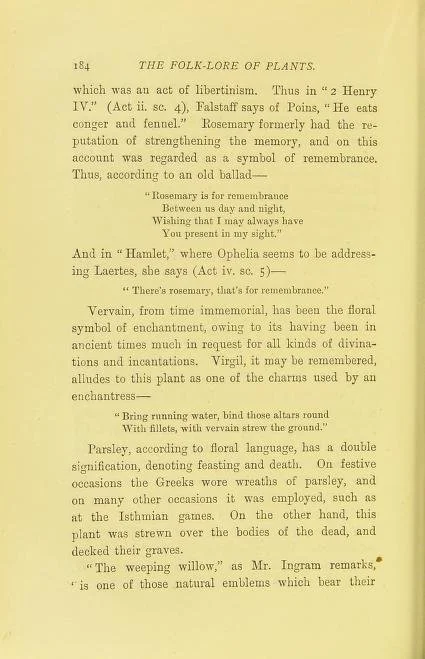
"The weeping willow," as Mr. Ingram remarks, "is one of those natural emblems which bear their signification so clear at first sight." This tree has always been regarded as the symbol of sorrow, and also of forsaken love.
Enid Baxter Ryce is the author of the books Plant Magic at Home, Ancient Spells and Incantations, The Borderlands Tarot, Field Guide to Fort Ord, and the forthcoming Grace Flows Through You. Her artwork has been exhibited at the National Gallery of Art, the Getty, and the Library of Congress. She’s a professor at CSU Monterey Bay, a fellow of the Sephardic Stories Initiative, and makes her art supplies from plants in her garden. Subscribe for weekly posts on ancestral wisdom, genealogy, and natural art practices.